
 English

 Spanish
 Portuguese


White-label vs. Customized iGaming Platform: Which Model Supports Sustainable Growth?
In the past decade, iGaming has seen exponential growth. But it has also spent it solving one problem, of market entry.
Although what once required significant technical investment and lengthy development cycles can now be achieved in a fraction of the time. For operators entering new markets, this transformation has been a major catalyst for growth.
Yet, as the industry continues to evolve and mature, the conversation around platform strategy is beginning to change. The challenge faced by operators today is not only limited to entering the market, but finding ways to remain competitive, scalable, and adaptable once they are there.
Across many jurisdictions, operators have access to similar game portfolios, payment solutions, and sophisticated acquisition channels. As competition intensifies, differentiation is becoming harder to achieve and more crucial than it was in the past. This shift is prompting operators to revisit a fundamental question of whether the platform that helped launch the system is scalable enough to support long-term growth.
The answer to this question often boils down to a choice between white-label and customised iGaming platform models. While both approaches have a role in the iGaming ecosystem, they are designed to address different business needs and growth objectives.
The Rise of White-label: Solving the Industry's Growth Problem
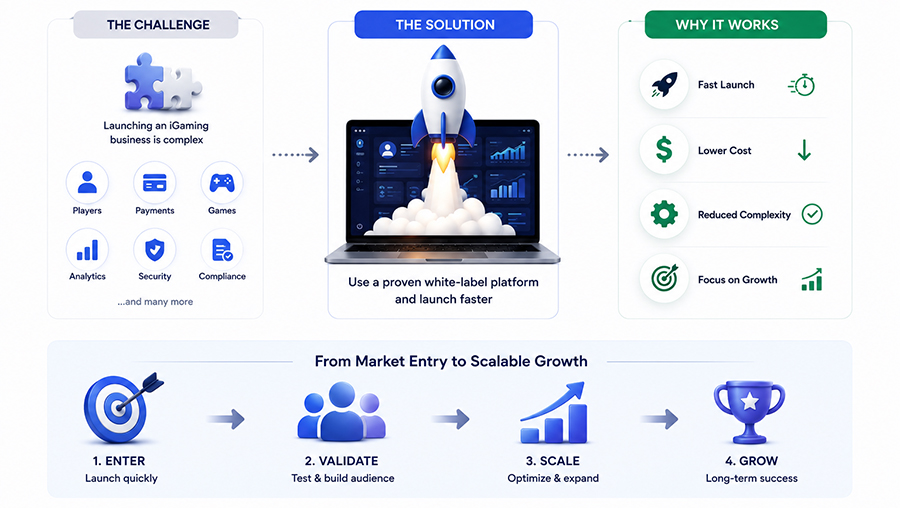
Launching an iGaming business involves far more than offering games or sports betting markets. Operators need player account management (PAM), payment integrations, responsible gaming tools, reports & analytics, security frameworks, compliance mechanisms, and much more. Building and maintaining these modules independently requires substantial time, expertise, and capital, hence, it is important to understand the challenges operators faced that led to the widespread adoption of white-label platforms.
Rather than building a technology ecosystem from scratch, operators could leverage an existing platform while focusing their limited resources on brand development, customer acquisition, and market expansion. For many businesses, particularly those entering new or emerging markets, this model significantly reduced operational barriers.
A typical white-label platform includes the essential components required to launch and run an iGaming business. These often include player account management systems, game integrations, payment processing capabilities, CRM tools, back-office functionality, security infrastructure, and regulatory support mechanisms.
The value proposition is straightforward, instead of investing heavily in technology development, operators can enter the market faster and begin generating revenue sooner. And, in an industry where timing can significantly influence success, this advantage remains highly relevant.
To think about why white-label continues to appeal to operators despite growing discussions around platform customization is interesting because these solutions continue to play a critical role in the industry.
The most prominent reason would be the speed. New opportunities emerge quickly, particularly in recently regulated markets. Operators want to establish an early presence and often prioritize launch timelines over extensive product customization. A white-label iGaming platform allows businesses to capitalize on these opportunities without delays.
Cost considerations also remain crucial. Not every operator is looking to build a proprietary technology ecosystem from day 1. For businesses exploring a new market or operating with limited technical resources, white-label platforms provide the best starting point. They are particularly relevant for operators at the market-entry stage, where the objective is to launch quickly, validate demand, and do so without taking on the full financial and operational commitment of owning the platform stack from the outset.
Equally important is the reduced operational complexity. Running an iGaming platform involves continuous maintenance, updates, compliance management, and technical oversight. White-label providers assume much of this responsibility, enabling operators to focus on commercial priorities rather than technology management.
For many operators, particularly those in the early stages of growth, these advantages are compelling. White-label platforms allow businesses to validate market demand, establish a customer base, and build operational experience without assuming the entire burden of ownership.
However, once the market-entry barrier has been overcome, operators seek to scale as priorities evolve.
The New Reality: When Market Entry Stops Being the Biggest Challenge
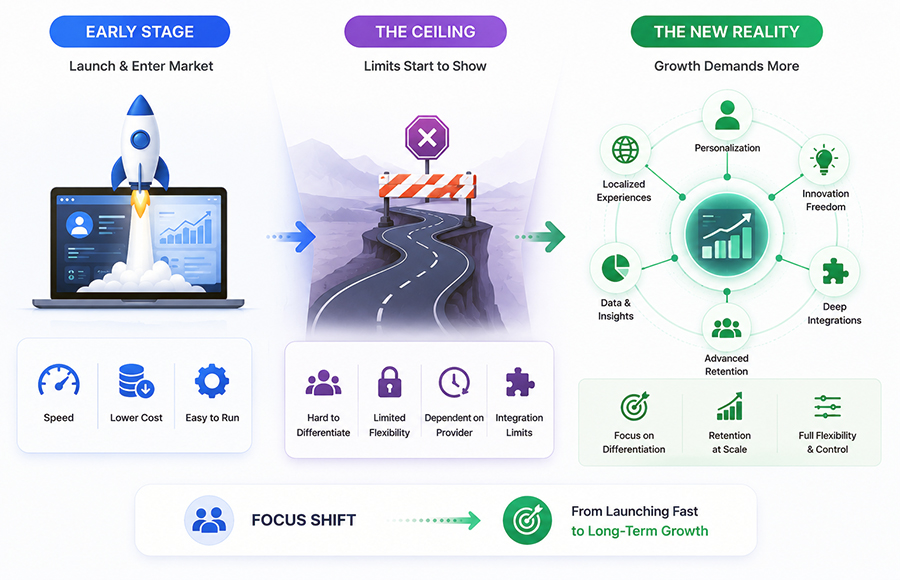
The factors that drive initial success are not always the ones doing the same during growth. In many mature and emerging markets, operators are beginning to encounter a different competitive scenario than the one that existed a few years ago: player acquisition costs are on the rise, retention strategies are getting more sophisticated, and the regulatory landscape is evolving. Alongside, player expectations are also changing around personalization, engagement, and user experience. And as a result of this, differentiation is moving to the forefront of strategic discussions.
In reality, many operators today now compete in increasingly similar ecosystems since access to premium content is widespread, payment solutions are more standardized, and marketing channels are much more crowded. As these variables become less distinct, operators’ focus shifts to other differentiating factors that can give them a competitive advantage. This is often the turning point where platform strategy becomes more of a strategic business consideration. Hence, as priorities change and operations scale, white-label platforms reach their ceiling.
While white-label platforms are designed to deliver speed, efficiency, and consistency, and while these strengths remain an integral part of an iGaming platform, the same characteristics cannot always create efficiency. They can also introduce constraints as the businesses mature.
The most prevalent challenge relates to differentiation. In highly competitive markets, operators are constantly looking for ways to create unique experiences that strengthen player engagement and brand loyalty. These may include proprietary reward structures, unique promotions, personalized messaging, or localized content tailored to specific audiences. The challenge is not only feature depth, but sameness. In a shared environment, it can be difficult to build a brand identity that feels meaningfully distinct when multiple businesses are working within broadly similar product structures, engagement mechanics, and user experience frameworks.
Another area of friction is innovation, and white-label environments are built in accordance with the technology provider’s development roadmap, so while platform providers continuously work on enhancing and updating their systems, operators don’t have any direct control over feature prioritization or release timelines. While this dynamic doesn’t pose a threat or roadblock during the launch phase, as the business grows and scale and differentiation start to become a priority, dependence on external roadmaps can limit agility.
Integration flexibility can also become a strategic concern as operators mature. Growth-stage businesses often need to connect to a wider ecosystem of partners and tools, whether that means market-specific payment methods, third-party engagement platforms, analytics layers, affiliate systems, or bespoke CRM workflows. In a standardized white-label environment, the depth of integration and the freedom to plug in new components may not always match what a scaling operator requires.
Localisation can also become important as the business expands across jurisdictions. What works in European markets does not work in African markets, for example. Different markets demand different payment preferences, player engagement models, regulatory adaptations, and user experience considerations. White-label platforms can support this only to an extent, but they reach their ceiling when operators are pursuing highly targeted market strategies that require greater flexibility than standard environments can offer. As volumes grow and market complexity increases, shared environments can also introduce practical scaling constraints, especially where operators need more control over integrations, performance, or region-specific operational workflows.
Most importantly, retention strategies are becoming sophisticated and are prioritised across the industry. Operators invest heavily in player segmentation, behavioral targeting, loyalty frameworks, and personalised engagement strategies. These often require deeper integration between business strategy and platform capabilities.
As retention becomes a larger driver of profitability, platform flexibility becomes a larger strategic consideration.
Strategic Value of Customized Platforms Beyond Features
Conversations around customized platforms often focus on functionality, but while features certainly matter, the growing interest in customization is being driven by other business considerations.
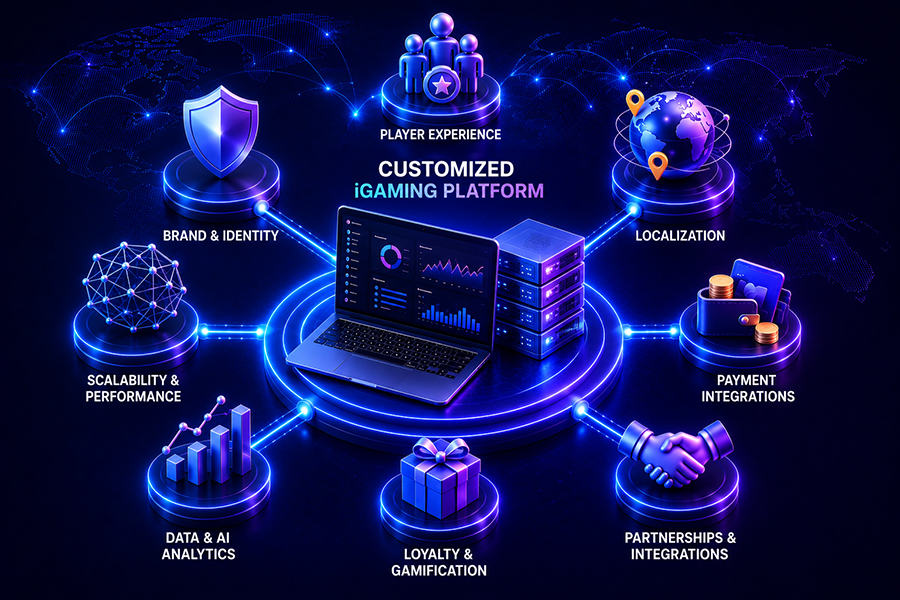
At its core, customization is about alignment. Rather than adapting business objectives to fit an existing platform framework, operators can shape technology around their strategic priorities. This creates opportunities to design experiences, workflows, and operational structures that support their specific business goals. In practical terms, that means greater control not only over the player experience, but also over brand identity, market-specific integrations, and the wider partnership ecosystem that increasingly shapes long-term growth.
The shift towards a customized platform is not a reflection of dissatisfaction with white-label platforms; rather, it reflects an operator's changing requirements as the business scales. As businesses scale, expand into new markets, diversify product offerings, and invest more heavily in retention and engagement, technology often becomes a more central component of competitive strategy.
The question shifts from whether the platform is quick to market or can support operations to whether it can support scale and differentiation.
The strongest advantage for customization is not flexibility; it is the ability to create competitive advantages that are difficult to replicate.
A customized platform gives operators greater control over the player experience, including registration journeys, promotional mechanics, loyalty programs, gamification frameworks, and retention initiatives, all designed around specific audiences. This is valuable in markets with evolving player expectations. Operators that can adapt this quickly often gain a stronger ability to respond to changing behaviors and emerging opportunities. Customization also supports faster innovation cycles rather than waiting for broader platform updates. Operators can prioritize developments that directly align with their strategic objectives.
Another significant advantage lies in localization. While many white-label platforms support multiple markets, they lack deep localization, including market-specific payment ecosystems, localized content strategies, region-specific engagement mechanisms, and operational workflows designed around local realities. A customized iGaming platform gives operators the confidence and means to accommodate local preferences more efficiently.
Data is another area where customized infrastructure creates value. iGaming businesses generate large volumes of player data, but the ability to turn that data into meaningful insight and action depends heavily on the platform's capabilities. A customized iGaming platform can support advanced analytics, personalized engagement models, and business intelligence frameworks that align with specific operational objectives.
Customization can also create more room for partnership-led growth. Operators that want to build bespoke content relationships, integrate local payment ecosystems, support affiliate or B2B partnerships, or expand into new markets with different operating requirements often benefit from a more open and controllable platform architecture. In that sense, a customized platform not only supports scale in terms of player volume; it can also support scale in terms of commercial ambition.
Finally, customized iGaming platform offers a level of strategic ownership that many growth-focused operators increasingly value. The objective has moved far from just entering a jurisdiction or business and is more about scaling and long-term competitiveness.
White-label Vs. Custom: Choosing the Right Model for the Right Business Stage
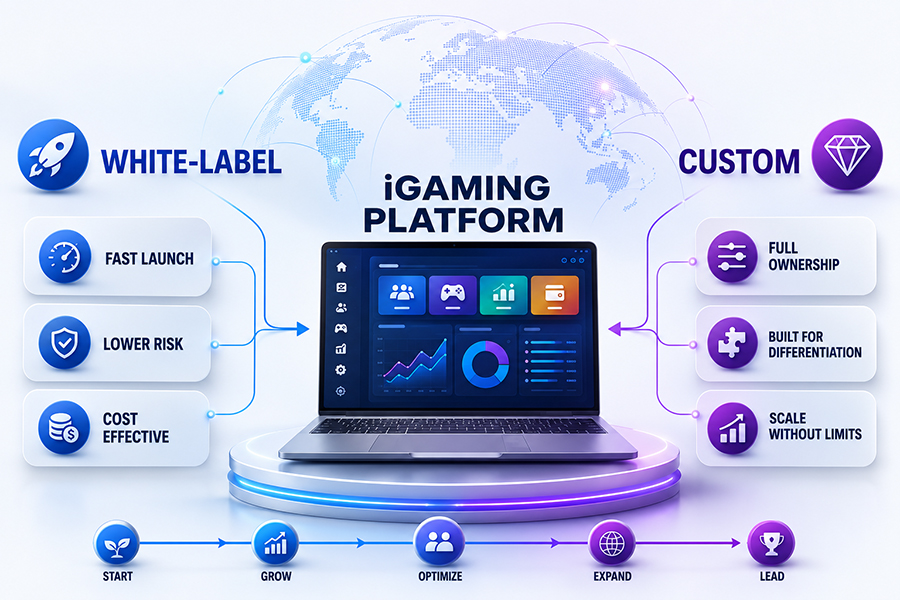
One common misconception in platform discussions is the assumption that one model is inherently better than the other. In reality, the two models are designed to solve different business needs.
For operators entering the industry, entering new jurisdictions, validating a concept, or prioritizing speed-to-market, white-label platforms often reflect the most practical and commercially efficient choice. The ability to launch quickly, minimize technical complexity, and reduce upfront investment can create significant advantages during the early stages of growth, particularly where the goal is to test market demand or establish an initial presence without taking on the full burden of platform ownership from day one.
As businesses mature, however, the priorities begin to shift. The challenge has shifted from entering the market to gaining traction and staying relevant.
Growth-stage operators may start exploring hybrid approaches that combine the efficiency of existing infrastructure with targeted customization, getting the best of both worlds. This allows them to address specific business requirements without undertaking a complete platform transformation.
However, for operators who are expanding across multiple markets, investing heavily in retention strategies, and pursuing highly differentiated brand positioning, customized platforms are more attractive. At this stage, flexibility, ownership, integration freedom, and adaptability carry greater strategic value than speed to market. These are market-leading operators who frequently view technology not just as operational infrastructure, but as a competitive asset that supports long-term differentiation, multi-market expansion, and broader partnership ambitions.
The key takeaway is that platform selection should reflect business maturity rather than industry trends.
Platform Strategy as a Growth Strategy
The debate between white-label and customized iGaming platforms is not about choosing a universally better model, it is about understanding which model best supports the current stage of a business’s growth and future ambitions.
White-label platforms remain highly effective for businesses that need speed, lower upfront investment, and reduced operational complexity. They solve the problem of how to enter the market quickly and efficiently, and for early-stage operators, that advantage can be decisive. At the same time, sustainable growth requires more than market entry. As competition intensifies and operators place greater emphasis on retention, localisation, innovation, and differentiation, the platform itself becomes a strategic growth lever. At that point, the limitations of a shared environment can become more visible, and the value of customization becomes much stronger.
Ultimately, the right platform model is the one that aligns with the operator’s commercial maturity, market strategy, and long-term objectives.
Learn more about Skilrock here: www.skilrock.com