 English

 Spanish
 Portuguese


Why Legacy Lottery Systems Struggle with Modern Demand
For decades, lottery technology was built around a clear set of priorities: reliability, transactional integrity, security, regulatory control, and uninterrupted operations. Many legacy lottery systems still perform these core functions effectively.
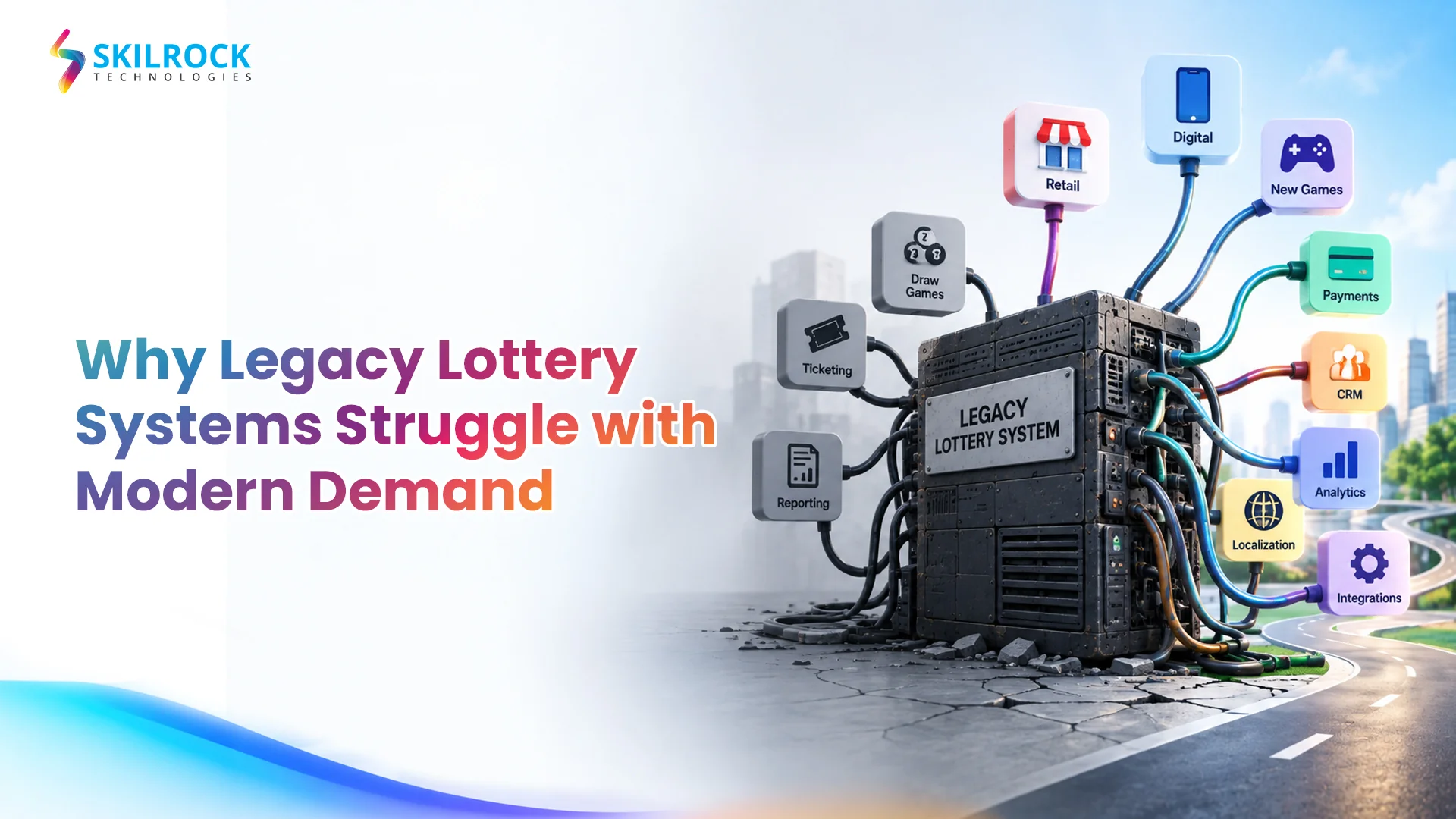
One major challenge is that the environment around them has changed. Lottery operators are no longer managing retail-based businesses predominantly with predictable product cycles and relatively contained technology ecosystems. Players move between retail and digital channels, while operators need to integrate new games, payment methods, CRM platforms, analytics tools, identity services, and engagement technologies. Markets require greater localization. Business teams expect faster access to data, and technology teams are under pressure to release enhancements without putting business-critical operations at risk.
As these expectations accumulate, the issue is not simply that a system is old; the real problem is that an architecture designed for an earlier operating model is being asked to support a fundamentally different one.
That gap between what the technology was built to do and what the business now needs is where legacy lottery systems begin to struggle.
Legacy Systems Were Built for a Different Lottery Business
Traditional lottery infrastructure was typically developed to address specific operational requirements extremely well. It supported draw games, ticket transactions, retailer networks, validations, claims, reporting, and other core processes within comparatively stable operating environments, and that stability was an advantage.
However, over time, operators added new channels, applications, integrations, products, databases, reporting layers, and third-party systems around the original technology. What began as a dependable core gradually became a complex ecosystem of interconnected components, each dependent on another. The system may still process transactions reliably, yet even a seemingly straightforward business change can become difficult.
Launching a new channel can affect multiple systems. Adding a payment provider may require significant integration work. Creating a unified customer journey can become difficult when retail and digital platforms maintain separate records. Even relatively small changes may require extensive testing because teams need to understand what else could be affected and that is where technical age starts becoming a business constraint.
1. Retail and Digital Operate as Connected Channels in Theory, but Separate Systems in Practice
Modern lottery players do not think in terms of technology stacks; they may discover a game online, purchase through retail, check a ticket on mobile, receive communication digitally, and return to a physical outlet later. From their perspective, every interaction belongs to the same lottery brand.
Legacy architectures were rarely designed around this behaviour. Retail, web, mobile, self-service, player accounts, payments, promotions, and reporting were mostly introduced at different stages of the technology lifecycle. Consequently, each channel carries its own processes, data structures, interfaces, and business rules.
Operators may technically offer multiple channels without having a truly omnichannel operation. This fragmentation creates challenges beyond player experience. Different systems can mean separate operational workflows, duplicated integrations, fragmented reporting, inconsistent information, and greater reconciliation requirements.
Modern demand therefore goes beyond simply having both retail and digital channels. Operators increasingly need those channels to function as parts of one connected operating environment.
2. Every New Integration Adds More Complexity
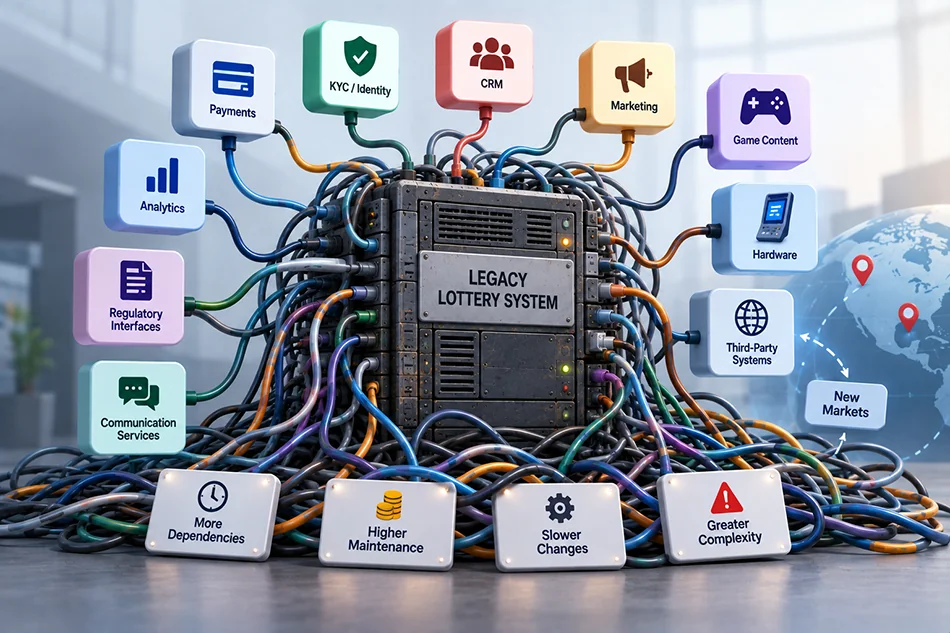
The lottery technology ecosystem has expanded considerably. Operators need to connect payment gateways, KYC and identity providers, CRM systems, marketing technology, third-party game content, hardware, regulatory interfaces, analytics platforms, communication services, and numerous other systems.
For a modern architecture designed around APIs and modular integrations, this ecosystem can be managed as a normal part of platform evolution. But for many legacy environments, integrations are considerably more complicated because interfaces may depend on proprietary protocols, tightly coupled modules, custom middleware, older data formats, or point-to-point connections developed for specific requirements. One integration may therefore solve an immediate problem while adding another dependency that must be maintained indefinitely.
Over time, integration becomes an accumulating cost and operators are not simply maintaining the lottery platform, they are maintaining the growing network of connections surrounding it.
This becomes particularly restrictive when entering new markets since local payment options, reporting requirements, language preferences, distribution models, hardware ecosystems, and operational processes can differ substantially between jurisdictions. Technology that is difficult to integrate or customize makes localization slower precisely when operators need greater adaptability.
3. Product Innovation Begins Moving at the Speed of the Architecture
Player expectations change quickly and technology roadmaps need to respond at the same pace. In a tightly coupled legacy environment, however, introducing one capability can require changes across several dependent systems, which creates a difficult trade-off. The business wants to move faster, while technology teams need to protect the stability of systems responsible for high-trust, business-critical transactions.
As a result of this, development cycles become longer, testing expands, release windows become more conservative, and innovation becomes dependent on the availability of specialist resources and the consequences of changing existing code. However, none of this means the technology team is resistant to change. It is quite the opposite, the architecture makes change expensive.
Eventually, an operator's ability to innovate can become determined less by market opportunity and more by what the existing system can safely accommodate.
4. Data Is Available, but Not Necessarily Usable
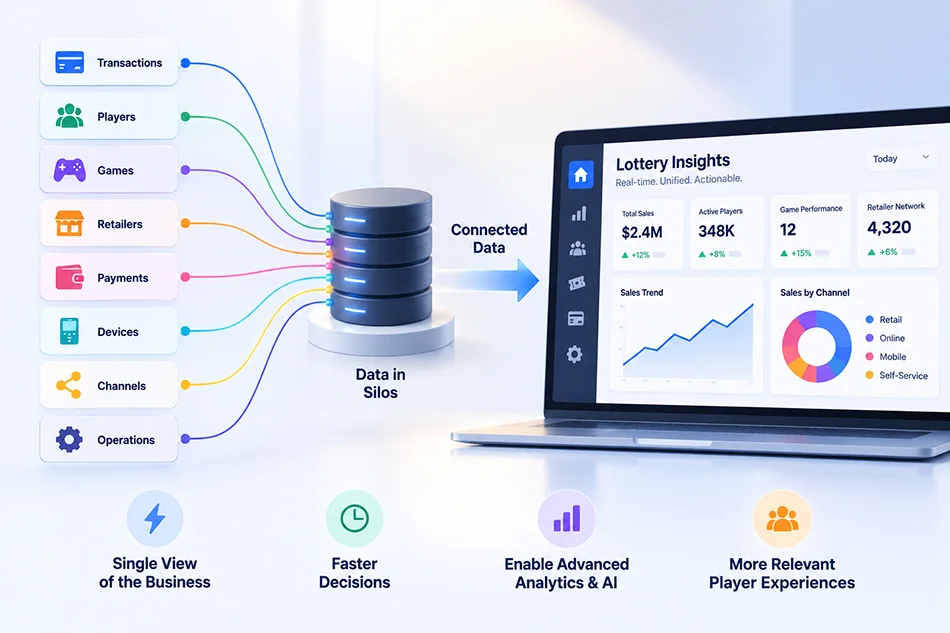
Lottery operations generate significant amounts of data across transactions, games, retailers, players, claims, devices, channels, payments, and operational systems. Having data, however, is different from being able to use it effectively.
In fragmented environments, information sits across separate databases and applications. Operational teams depend on scheduled reports, manual reconciliation, or extracts from multiple sources before they can understand what is happening across the business. That model becomes inadequate as operators move towards real-time decision-making.
With operations teams wanting immediate visibility into network performance, commercial teams wanting to understand game and channel performance, marketing teams requiring connected information to create relevant player engagement, management requires consolidated reporting rather than separate views of different parts of the operation.
More advanced analytics and AI create an additional requirement: accessible, reliable, structured, and connected data.
A legacy system can therefore become an obstacle to new analytical capabilities even when it already contains years of valuable information. The constraint is often not the absence of data but the difficulty of making that data useful.
5. Scale Is No Longer Just About Processing More Transactions
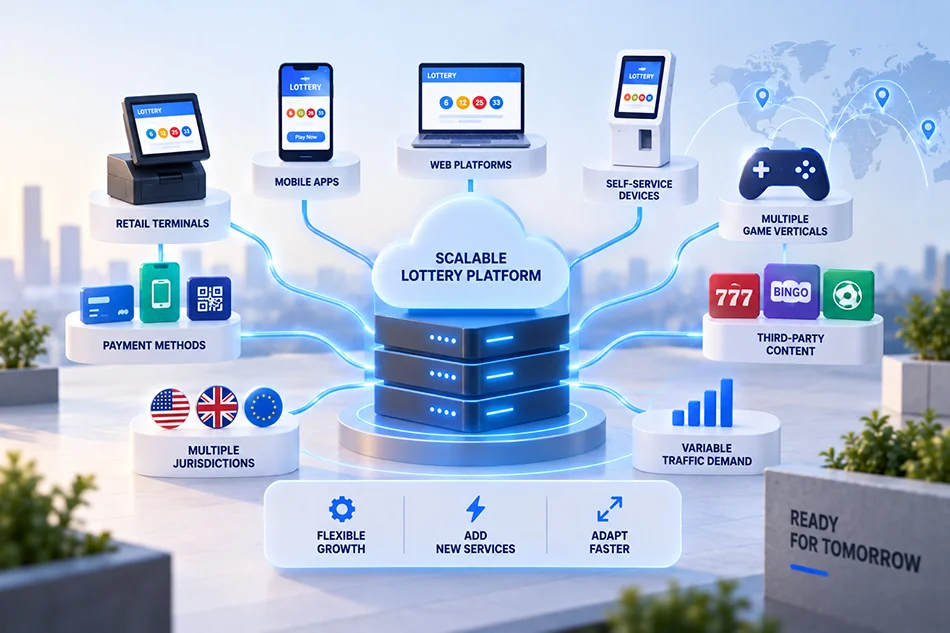
Historically, technology scale was often discussed primarily in terms of transaction volume. While that remains essential, the definition has widened. A modern lottery platform may need to scale across retail terminals, mobile applications, web platforms, self-service devices, multiple game verticals, third-party content, different payment methods, several jurisdictions, and varying patterns of traffic. Alongside this, it must also accommodate demand that can change rapidly.
This makes architectural flexibility important. Operators need the ability to scale individual capabilities, introduce additional services, and expand the technology ecosystem without redesigning the entire platform each time the business grows.
Legacy systems built as large, tightly interconnected applications can find this difficult. Scaling one area may require scaling much more of the system than the actual demand requires. The problem therefore becomes less about whether the platform can handle today's business and more about how efficiently it can adapt to tomorrow's.
6. Maintenance Starts Competing with Innovation
Every mature system carries technical knowledge accumulated over years. However, in legacy environments, that knowledge becomes concentrated among a relatively small number of specialists with incomplete documentation, accumulated customisations, and components that depend on older technologies with which fewer engineers are familiar.
The system can still function reliably, but the cost of understanding and changing it continues to increase. This creates an invisible constraint on engineering capacity. When significant amounts of time are spent maintaining older integrations, investigating dependencies, reconciling data, or supporting customised components, there is less capacity available for initiatives that directly advance the business. This gradually makes technical debt an opportunity cost where the business has a backlog of requested capabilities and technology has to evaluate every change against years of dependencies.
7. Security and Compliance Requirements Keep Evolving
Fundamentally, lottery is a high-trust business and elements like security, traceability, controlled access, transaction integrity, auditability, responsible gaming, and regulatory reporting cannot be treated as optional enhancements. These are foundational requirements.
Legacy systems are engineered with strong controls for the regulatory environments in which they were originally deployed, but security and compliance are not static. New channels introduce new attack surfaces, more integrations create additional access points, and digital player relationships introduce identity and data-management requirements. Therefore, regulatory reporting can become more sophisticated and requires security practices to continue to evolve alongside infrastructure and application architecture.
And hence, maintaining modern controls around complex legacy environments can require considerable effort.
Why Continuous Patching cannot be a Long-term Strategy
Immediate replacement is rarely a natural response to technical constraints. Operators often prefer to add APIs, introduce middleware, build digital applications around existing ones, create data layers, etc. and it is the most commercially and operationally sound approach. It protects existing investments and reduces disruption. The issue arises when this increases architectural complexity. At this point, an organization spends more effort enabling the environment to support change rather than delivering the change itself. This is usually when the modernization conversation moves beyond individual features.
Although modernization certainly does not mean replacing everything at once, it needs to be progressive. Operators need to identify the components that continue to perform effectively and distinguish them from the ones that create genuine business constraints. This approach changes modernization from a technology replacement project into a business capability programme.
This is an important distinction because the objective is not to have the newest architecture but to make the business easier to change.
What Should a Modern Lottery Platform Enable?
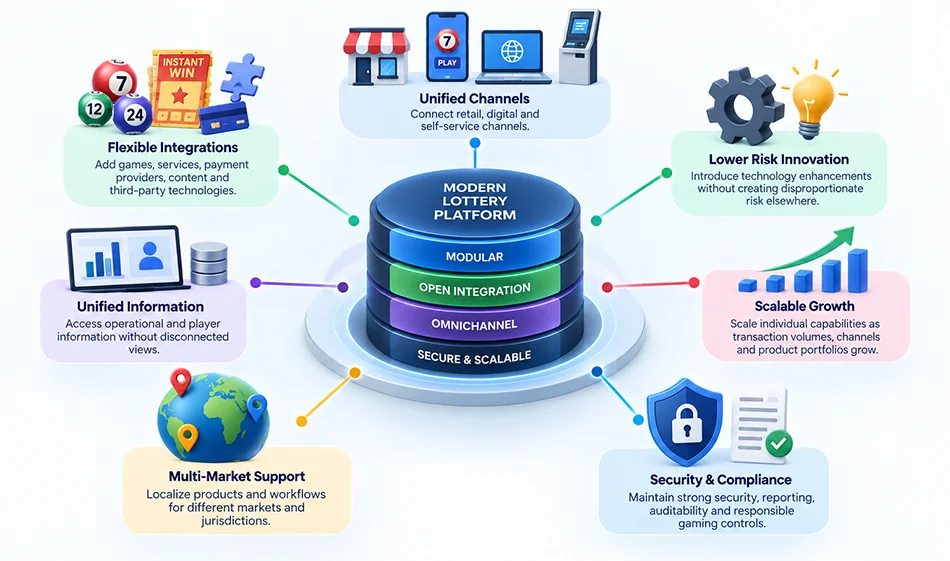
The strongest measure of modern lottery technology is not how many features appear on a product sheet. It is how effectively the platform allows an operator to respond to changing business requirements.
A future-ready architecture should make it easier to:
- connect retail, digital, and self-service channels within a unified operating environment;
- add games, services, payment providers, content, and third-party technologies through flexible integrations;
- access operational and player information without assembling multiple disconnected views;
- localize products and workflows for different markets and jurisdictions;
- scale individual capabilities as transaction volumes, channels, and product portfolios grow;
- introduce technology enhancements without creating disproportionate risk elsewhere in the platform;
- maintain strong security, reporting, auditability, and responsible gaming controls as the ecosystem evolves.
Modularity matters because operators should not have to rebuild an entire platform to improve one part of their operation.
Open integration matters because no lottery technology provider operates in isolation.
And omnichannel architecture matters because players increasingly experience the lottery brand as one ecosystem, regardless of where a transaction begins.
The Real Cost of Legacy Technology Is Lost Agility
Legacy lottery systems often remain operational long after they become strategically restrictive, which is why the modernization decision cannot be based purely on uptime or system stability.
A platform that is available, secure, and capable of processing transactions can still make every new initiative slower, more expensive, and more complicated than it needs to be. This cost appears in longer integration cycles, delayed launches, duplicated processes, disconnected data, limited flexibility, greater maintenance requirements, and teams spending increasing amounts of time protecting the past instead of building the future.
For operators evaluating their next stage of growth, the objective should not be modernization for its own sake but architectural flexibility that allows the lottery business to evolve without continually fighting against its technology.
Learn more about Skilrock here: www.skilrock.com