 English

 Spanish
 Portuguese


The 5 Retention Mistakes Costing iGaming Operators Millions
Player acquisitions tend to dominate conversations in the lottery and iGaming industry. Marketing budgets are spent on attracting new players with advertising campaigns, sign-up bonuses, and referral incentives. And yet, 55% of iGaming players leave within a year of signing up.
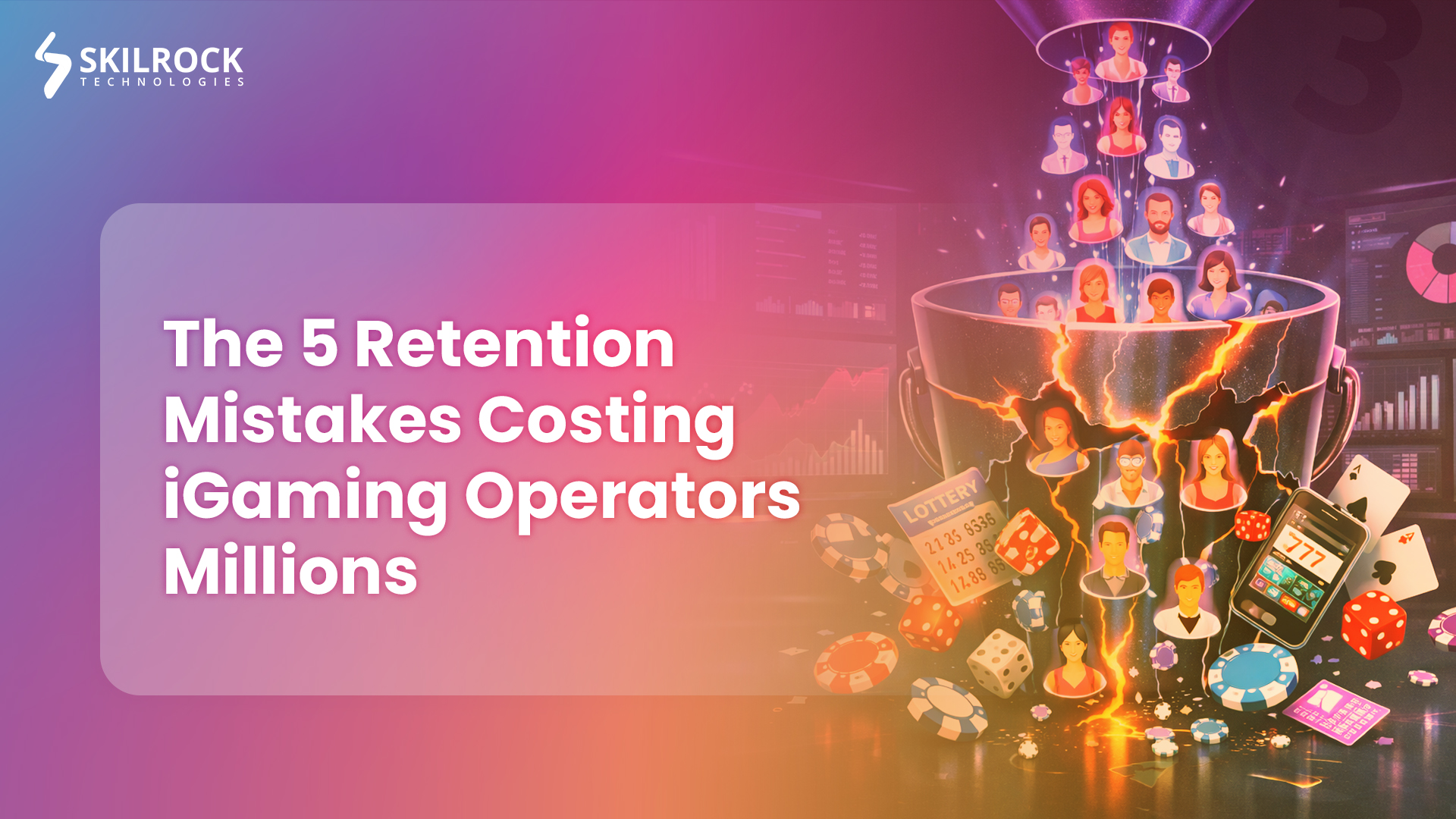
That single number exposes the flaw in acquisition-first thinking. Operators are filling a bucket that leaks faster than it fills. While acquisition often receives the spotlight, retention is where sustainable growth truly lives. And this is precisely where many lottery and iGaming operators get it wrong.
For decades, they could afford to. Massive jackpots, government backing, and near-universal brand recognition meant that operators didn't need to think too hard about keeping players around; new ones would always show up. But that structural advantage is eroding. Digital-native players have smaller attention spans, and younger demographics are harder to engage. Retention is becoming a strategic imperative, and yet most operators are making the same foundational mistakes.
Here are the most consequential ones.
1. Confusing Player Acquisition With Player Retention
One of the most common misconceptions in the lottery and iGaming industry is also the most expensive, which is pouring significant funds into acquiring new players and assuming that a good product will naturally keep them. While a good product is important, it is not enough, at least without deliberate efforts.
Acquisition and retention are two different disciplines that require different investment strategies, metrics, and organizational mindsets. Acquisition is about reaching the right person at the right moment with a compelling reason to try. Retention is about building a relationship that makes leaving feel like a loss.
Acquisition campaigns are designed to generate attention and urgency. They are transactional in nature, often centered around limited-time excitement or outsized prize pools. While these campaigns successfully draw lapsed players back into the market, they do little to establish habitual engagement.
Retention strategies, on the other hand, focus on reducing churn, increasing frequency organically, and strengthening the connection with the product. Acquisition brings the players in, and retention keeps them there. Confusing the two not only inflates marketing costs but also creates unstable revenue patterns. The economics make the distinction critical. Research across digital industries shows that acquiring a new customer costs five to seven times more than retaining an existing one.
2. Ignoring Player Lifetime Value

All players are not the same. They do not contribute equally to the long-term revenue. They should not be treated as a monolithic group because this approach leads to generic campaigns that fail to address the needs and behaviors of distinct segments.
Lifetime value segmentation allows operators to understand which players generate sustained engagement over time, which are occasional participants, and which are at risk of churn. Without this segmentation, retention lacks effort. All require attention, but in different ways. High-value players warrant personal outreach, exclusive experiences, and proactive services. Mid-tier players represent the most compelling retention opportunities; a modest investment here can lead them higher up the value curve. In comparison, the casual players need frictionless reactivation when they go quiet, not expensive one-on-one treatment.
Segmentation is not about favoring certain players unfairly; it is about aligning communication and incentives with behavioral patterns. A frequent digital player who engages weekly should not receive the same messaging as someone who purchases once every few months at retail. Each group has different motivations, expectations, and responsiveness to promotions.
By ignoring lifetime value, operators either over-invest in non-recurring players or neglect those who offer high value in the long run. Both scenarios erode the margin without improving retention.
3. Not Tracking Player Behavior for Personalization

Personalization is the bare minimum; modern customers expect personalization. Streaming services recommend content based on viewing history. Retail platforms curate product suggestions aligned with purchase behavior. The effectiveness of personalization is well documented. In the iGaming sector, personalized CRM communication has been shown to increase player lifetime value by more than 40%, underscoring the importance of using behavioral data effectively.
Lottery and iGaming operators have access to behaviorally rich data, such as a player’s preferred game, time spent playing, how they respond to different communication formats, and their motivations, etc. Most operators track this data, but very few use it systematically and analytically to personalize the player experience. This undermines retention potential, and operators miss the opportunity to deepen engagement. Communication channels also play a role. Email marketing campaigns in iGaming consistently deliver conversion rates up to three times higher than social media marketing efforts, making targeted messaging a critical retention tool.
The gap between data collection and data activation is where retention fades. If a player is not receiving the right communication, over time, they learn to ignore it altogether, which is the first stage of disengagement. Personalization in this context doesn’t have to be a complete technological overhaul; it starts with basic behavioral segmentation, which is communicating with the players based on what they do rather than what the operator wishes they would do. From there, operators can work on and fine-tune next-best action recommendations, dynamic content, and promos, among other things, based on player history. These subtle adjustments make communication feel relevant rather than promotional.
4. Underestimating Second-Chance Games

Second-chance games are often used as supplementary features rather than core retention tools. It is one definite way of extending the lifecycle. The concept is rather straightforward: a player who holds a non-winning ticket still gets a second opportunity to enter a secondary competition.
For most players, losing is the default experience. The psychological accumulation of loss, even when expected, gradually erodes motivation to keep playing. Second-chance games interrupt that pattern. What this does is rewire the player's emotions towards a non-winning ticket. Usually, when a ticket loses, the experience ends immediately, almost abruptly. Second-chance opportunities soften this endpoint. It creates a sense of participation that endures, even after the primary draw concludes. This extended engagement increases the perceived value of the ticket and encourages recurring play.
Further, second-chance games can be integrated into digital platforms, offering an omni-channel gameplay. One effective way to achieve this is by allowing retail players to scan a losing ticket through their mobile phones, which instantly connects them to a digital second-chance draw. This frictionless handoff between the physical ticket and the digital world transforms a losing moment into a re-engagement opportunity, keeping the player in the experience rather than walking away. Skilrock’s Scan-N-Play is built on this mechanic. A retail player who scans a losing ticket automatically enters a second drawing, which is now digitally connected. This creates an important and powerful retention lever. With strategic structuring, it can serve as a useful tool to increase participation and strengthen the continuity of a player’s lifecycle.
5. Overreliance on Jackpot Size

Jackpots are an important motivator, but they are not all of it. Hence, over-reliance on the jackpot size as the primary driver of player engagement leads to neglect of the broader product and experience architecture that determines player engagement between headline draws.
The issue with jackpot-led engagement is that it is inherently cyclical. Player activity spikes with jackpot prizes and contracts sharply once they are won, and the cycle resets. Operators that do not build engagement layers alongside this find themselves in an acquisition loop of constantly refilling a player base that empties every time rollover ends.
Operators who overcome this most effectively focus on game variety, in-app content and entertainment value, loyalty programmes with meaningful rewards, and community features that connect players to something larger than just the individual ticket.
Jackpot size draws attention; everything else is what converts attention into a lasting relationship.
Rethinking Retention as a Strategic Imperative
The five mistakes outlined here share a common root: a tendency to treat player retention as something that happens passively, as a byproduct of running draws and marketing jackpots. It doesn't.
The economics of retention make a compelling case for change. Acquiring a new player costs anywhere from five to seven times more than retaining an existing one. Yet across the industry, acquisition continues to command the lion's share of marketing budgets, while retention is treated as a secondary concern. The result is a leaky bucket, where the operators are perpetually refilling a player base that drains faster than it grows.
The demographic pressure also adds to the urgency. Younger players are growing up in an environment of personalization. They have higher expectations and lower tolerance for irrelevant communication. For this cohort, just a jackpot is not a reason enough to stay.
The upside to this is that the structural tools to get this right already exist. Lifetime value segmentation does not require a complete rebuild. Behavioral personalization can begin with simpler logic before it becomes sophisticated. The infrastructure is available; what has been missing is the strategic will to deploy it with retention as the primary objective.
The operators that succeed in the coming decade will be those that treat retention as a core capability rather than an afterthought. Acquisition may bring players through the door, but retention is what ultimately determines whether they stay.