English

 Spanish
 Portuguese


Business Cost of Broken Player Trust in iGaming
Lottery and iGaming operators measure performance with increasing precision. Deposits, active players, retention, churn, campaign response, transaction values, and player lifetime value are closely monitored because they indicate how efficiently the business is acquiring, engaging, and retaining players.
Yet many of the events influencing these numbers are still viewed independently. A declined deposit is treated as a payment issue. A delayed withdrawal becomes an operational concern. Platform latency sits with technology. A wallet discrepancy reaches customer support. Irrelevant promotions are measured through marketing performance, while authentication and account-security concerns are managed elsewhere.
For the player, these are not separate systems, departments or KPIs. They are all interactions with the same operator.
This is where player trust becomes commercially significant. Trust is built through the consistency of transactions, gameplay, payments, communication, account management and support. When these interactions work reliably, the player gains confidence in the platform. When they repeatedly fail, that confidence weakens and eventually starts influencing the metrics operators already track: repeat deposits, engagement, retention, and lifetime value.
The challenge is that operators usually see the operational incident long before they see the commercial cost of lost trust. That link is already visible in player behaviour: a 2025 study across 4,300 online players in Europe, North America, and Latin America found that 82% consider the payment experience an important factor in deciding whether to continue playing.
Trust is an Outcome of the Entire Player Journey
Trust in lottery and iGaming is different from conventional brand affinity because money is involved in almost every important interaction. Players need confidence that deposits will be processed correctly, balances will remain accurate, games will work as expected, winnings can be withdrawn, personal information is protected, and assistance will be available when required.
This means trust cannot be created by marketing alone. It is an outcome of the entire operating environment.
An operator may have a strong acquisition campaign and an engaging game portfolio, yet the player experience can still deteriorate if the payment journey is inconsistent or the wallet does not update correctly. Similarly, a smooth gaming experience can quickly be overshadowed by a withdrawal that remains unexplained for too long. Even a technically minor problem can become significant when it involves a player's money or account.
This is why trust should be viewed less as an abstract perception and more as a consequence of how reliably different parts of the platform work together.
Failed Transactions Create Doubt at the Point of Highest Intent
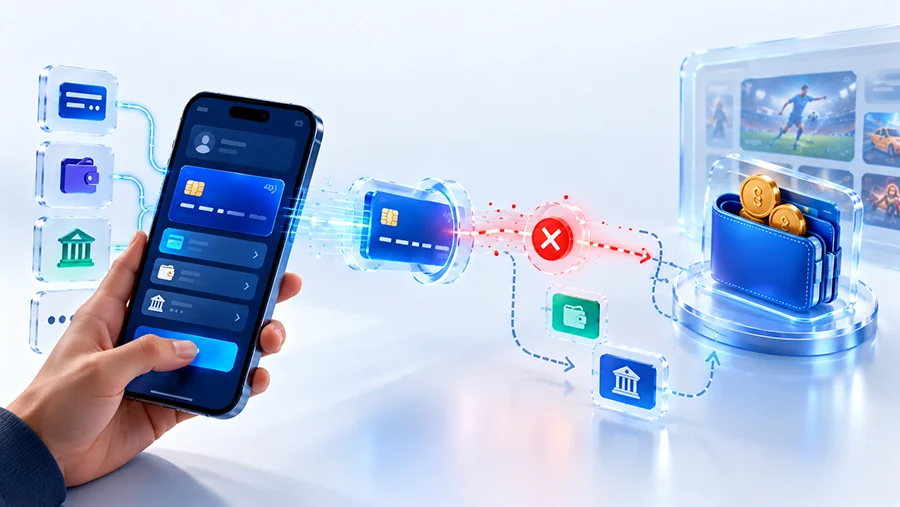
A deposit is one of the clearest expressions of player intent. By the time a player reaches the payment stage, the operator has already invested in attracting that player, providing an onboarding journey and creating enough interest for them to commit funds.
When the transaction fails, the immediate effect is a missed or delayed deposit. However, the wider impact depends on what happens next.
Payment environments in lottery and iGaming can involve multiple gateways, local payment methods, banks, wallets, routing rules, and third-party integrations. Internally, a failure may have a perfectly identifiable technical reason. The player does not necessarily see any of this complexity. They simply see that the transaction they wanted to complete did not work.
One failed payment may be retried. Repeated failures change the experience. They create uncertainty around whether the platform can manage financial transactions reliably, particularly when error messages provide little explanation or alternative payment routes are not readily available.
For operators, this is where payment performance needs to be examined beyond transaction success rates. Failed payments can also be connected to retry behaviour, abandonment, subsequent deposit activity and support contacts. This gives a more complete picture of whether payment friction is simply creating an operational exception or beginning to affect player confidence.
Withdrawals Carry a Different Weight
Operators naturally optimise deposits because they enable gameplay. Withdrawals, however, play an equally important role in determining whether players trust the broader financial relationship.
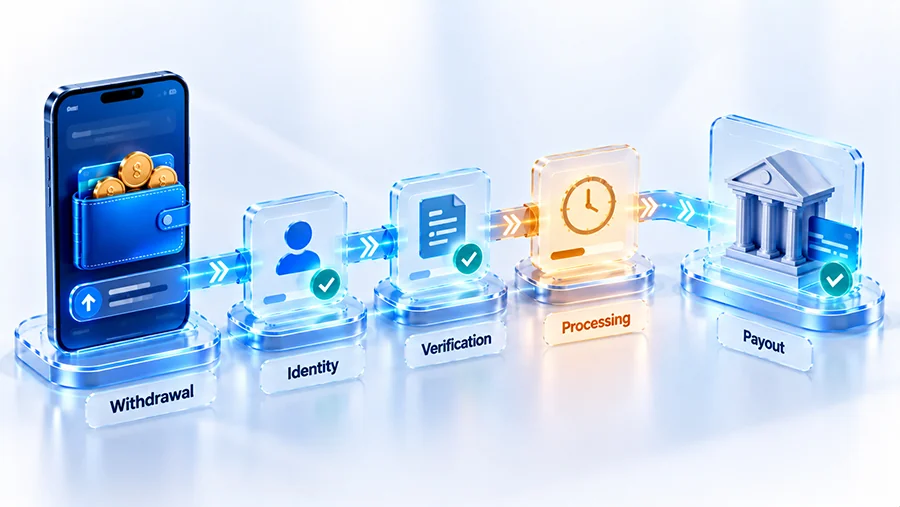
When a player requests a withdrawal, the expectation is not only that the money will arrive but that the process will be understandable. Verification, fraud controls, compliance requirements and payment-provider processes can all influence payout timelines, and some delays may be necessary. Problems arise when the player has little visibility into what is happening.
A withdrawal that remains pending without explanation can create more uncertainty than one that takes the same amount of time but provides a clear status and next step. This makes transparency an important part of the payout experience. Operators need to understand withdrawal performance not simply through average processing times but also through the operational steps creating delays, the communication surrounding them and the behaviour that follows.
Platform Reliability Is Experienced at Transaction Level
Traditional technology monitoring often focuses on availability, uptime and infrastructure health. These remain critical, but they do not always reflect how the platform feels to an individual player.
A system may technically be available while a game takes too long to launch. A service may be running while a transaction times out. A player may be able to log in but encounter a wallet balance that has not yet been updated. An intermittent integration failure may affect only a small percentage of transactions but still create a significant issue for the players involved.
From the player's perspective, these distinctions are largely irrelevant. The question is simply whether the platform worked when they needed it.
As lottery and gaming operations become omnichannel and more connected across web, mobile, retail, self-service, payments, third-party games, and external services, reliability increasingly depends on the performance of the ecosystem rather than one application in isolation.
The commercial relevance is straightforward. If repeated technical interruptions make gameplay or transactions unpredictable, players do not necessarily wait for an operator to resolve the architectural cause. They can simply reduce their activity or move elsewhere.
Disconnected Systems Create a Disconnected Player Experience
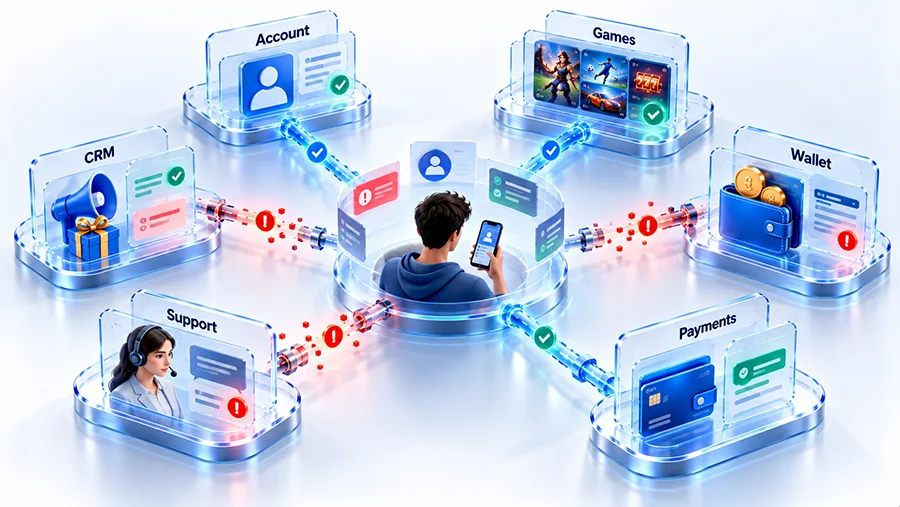
Fragmentation becomes very visible when multiple systems are involved in the same player journey. A player account may exist in one system, wallet information in another, game activity in several external platforms, promotions in a CRM, payments through multiple providers, and customer interactions in a separate support environment. Each component may perform its own function effectively, but the player experiences the combined result.
Salesforce research found that 85% of customers expect consistent interactions across departments. For lottery and iGaming operators, that expectation extends beyond departments to channels, wallets, payments, game systems, and service environments: players experience all of them as one operator.
This is where disconnected systems can turn relatively simple issues into trust problems. If wallet information does not reconcile quickly across channels, the player sees an incorrect balance. If customer support cannot easily access transaction context, the player may need to repeat information that the operator should already know. If promotion systems do not have a connected view of player behaviour, communication becomes generic or poorly timed.
The technical issue in each case is different, but the player perception is not. They see inconsistency.
For operators, the implication is that protecting trust requires more than improving individual touchpoints. The connections between those touchpoints matter just as much.
Irrelevant Promotions are also a Data Problem
Promotions are one of the most visible ways operators engage existing players, but relevance depends heavily on what the operator knows about each player and whether that information can be used effectively.
Generic promotions may generate some activity, but repeated communication that bears little relationship to the player's games, behaviour or lifecycle can gradually lose effectiveness. The challenge becomes more pronounced when player information is fragmented across different channels and systems.
A player may interact with lottery, casino, sports or instant games and move between devices or channels. If these interactions are viewed separately, marketing systems receive only a partial picture of the relationship. Connected data provides operators with a stronger foundation for relevant engagement. It allows communication, game recommendations, and offers to reflect actual activity rather than broad assumptions.
There is also an important responsible gaming dimension. Better player understanding should not simply be used to increase promotional frequency. It should help operators make more appropriate decisions about when and how to engage, including when intervention or reduced promotional activity is more suitable. The objective is therefore not more communication. It is communication that makes sense in the context of the player relationship.
Customer Support is where Operational Problems become Player Problems

Support teams often encounter the symptoms of issues created elsewhere in the operating environment. A payment integration fails, and support receives the query. A withdrawal takes longer than expected and support needs to explain the delay. A bonus rule is unclear, a balance appears inconsistent, or an account verification step creates confusion, and the service team becomes responsible for restoring confidence. This makes support one of the clearest indicators of where trust is under pressure.
Traditional support metrics such as response and resolution times remain useful, but operators can learn more by connecting service data with underlying operational events. Which transaction problems generate the most repeat contacts? Which issues lead to escalation? Do certain payment methods or gameplay journeys repeatedly create confusion? Does player activity change after a difficult support interaction?
This approach allows support information to become a source of operational intelligence rather than only a measure of service efficiency. It also reinforces an important point: solving the ticket is not always the same as solving the underlying player problem. If the same issue continues to appear across players, the solution may sit in the platform, workflow, or integration rather than in the support process itself.
The Data to Understand Lost Trust Already Exists
Player trust may sound difficult to quantify because operators do not have a single dashboard metric labelled "trust". However, many of the signals already exist within operational data.
Payment systems reveal deposit failures and retries. Wallet and transaction systems show reversals, discrepancies, and exceptions. Withdrawal workflows show processing times and manual interventions. Platform monitoring records latency and technical errors. CRM and marketing tools reveal engagement patterns. Support systems capture complaints and repeat contact. Player management systems show subsequent deposits, gameplay, inactivity and churn.
Individually, these metrics explain what happened within a particular function, but connected, they can explain something more valuable: what happened to the player afterwards, and this changes the questions operators can ask.
The value lies not in creating another KPI but in connecting operational signals with commercial behaviour.
The Real Impact Appears after the Incident
An incident has an immediate value attached to it; lost trust usually does not.
Its cost often emerges later, when a player does not retry a deposit, ignores the next promotion, becomes less active after a withdrawal problem, or gradually disappears following repeated friction. That is why trust remains easy to underestimate. Its commercial impact is distributed across other metrics rather than recorded as a separate expense.
For operators, the opportunity is not necessarily to find one new number called player trust. It is to become better at connecting the signals they already have. All parameters should not be analysed only inside their individual functions when the player experiences them as one journey.
The operators that understand these relationships can move beyond identifying where something went wrong and begin understanding what that failure actually cost the business because in lottery and iGaming, trust is not created by what an operator promises. It is created every time the platform, transaction, and experience work exactly as the player expects them to.
Learn more about Skilrock here: www.skilrock.com