
 English

 Spanish
 Portuguese


AI in Lotteries: Hype Vs Reality
Artificial Intelligence has fast become one of the most talked-about subjects in the global lottery and gaming industry. From conference panels to supplier presentations, AI is increasingly positioned as a catalyst to redefine player engagement, personalize experiences, optimize operations, and unlock new revenue opportunities. The narrative is compelling: smarter systems, deeper insights, automated analytics, and near-instant transformation. But, beneath the surface lies a much more complex reality.
Across industries, the gap between AI ambition and actual implementation remains significant. A report by McKinsey & Company revealed that over 55% of organizations are adopting AI in at least one function, but only a few have scaled it across their operations in a way that impacts financial performance, and the Lottery sector, with its legacy infrastructure and regulatory complexity, faces a steeper path.
AI is often bundled into every product pitch, presented as an all-encompassing solution rather than a targeted capability. What fruits from this is a landscape where operators are not short of options but are short on clarity. What does real AI adoption actually look like? Where does it deliver measurable value? And how can it be integrated without disrupting existing systems? These are important questions because lotteries operate in a uniquely sensitive environment.
What is increasingly clear is that the future of AI in the lottery industry will be shaped by practical, incremental adoption that delivers real outcomes. This article moves away from hype-driven narratives and focuses on what is actually happening across the industry, exploring the tangibility of AI, and understanding what differentiates meaningful implementations from surface-level experimentation.
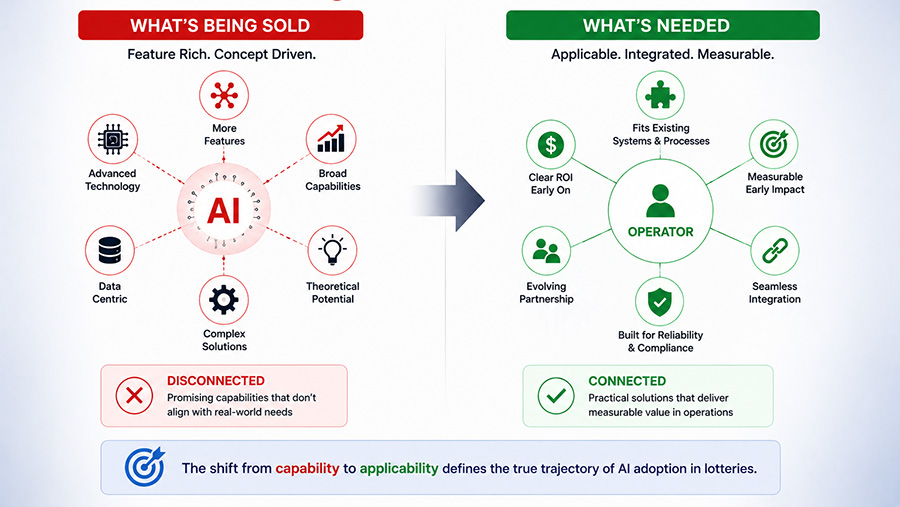
The Disconnect Between What’s Being Sold and What’s Needed
If the conversation is shifting from AI as a concept to AI as an operational tool, then the next question is: what does meaningful adoption actually require? Across the lottery industry, the answer is beginning to converge.
While AI capabilities continue to expand, operators are becoming more precise in their evaluation of them. The focus is no longer on the breadth of features but on how effectively those features can be applied in real-world environments. This is where a clear distinction begins to emerge between what is being presented and what is being prioritized.
From an operator’s perspective, AI is much more valuable if it fits into the systems and processes already in place. Lottery environments are not built for disruption at scale; they are built for continuity, reliability, and compliance. Accordingly, any new capability is expected to work within these constraints. This makes practical applicability far more important than theoretical potential.
Closely tied to this is the question of investment. AI is often positioned as a long-term transformation lever, but operators are increasingly looking for measurable returns that start early. Before committing budgets at scale, there is a need to see clear evidence of impact, including improvements in player engagement, operational efficiency, or risk reduction. Without that proof, even the most promising capabilities struggle to move forward.
Integration becomes another defining factor: Operators already rely on a range of systems and tools, many of which are deeply embedded in their workflows. AI needs to connect seamlessly with what is already in use. The expectation is not replacement, but augmentation. This further reinforces the philosophy that there is no need to reinvent the wheel.
Finally, there is an important shift in how operators view their technology partners. AI adoption is not a one-time deployment; it is an ongoing process of refinement. As a result, operators are placing increasing value on partners who are themselves evolving. Those who are actively working through or have worked on a similar adoption, rather than simply presenting finished solutions. Taken together, these expectations reshape the conversation around AI.
The emphasis moves away from what systems are capable of in isolation, and toward how they perform within the realities of lottery operations. And it is within this shift from capability to applicability that the true trajectory of AI adoption in the industry is being defined.
Where AI is Actually Creating Value in the Industry
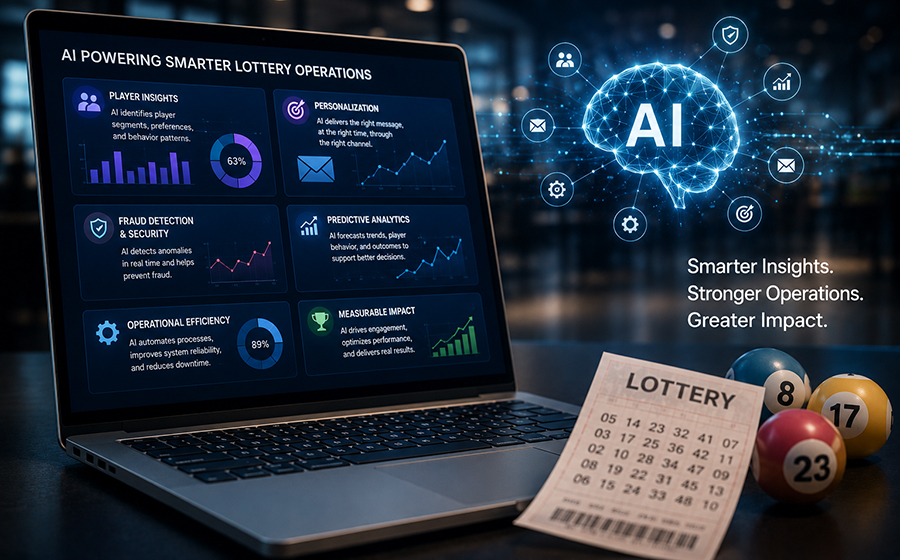
The role of AI in lotteries is no longer confined to early exploration. In specific areas of the business, it is already being applied in ways that are producing consistent and measurable outcomes.
One of the most visible areas is player segmentation. Traditionally, operators have relied on demographic groupings or transactional metrics, etc. AI, however, is changing this by enabling segmentation based on behavioral patterns by creating micro-segments, understanding play patterns, and lifetime value signals: how often players engage, what games they prefer, how their activity changes over time, and how they respond to different triggers. This shift is particularly important in a market where player bases are large and diverse. According to reports, annual lottery sales exceeds ~$300 billion annually, signifying both the scale of the audience and the opportunity to engage more intelligently.
Closely related to this, is the emergence of player preference intelligence. Rather than acting on past behavioral data alone, AI models are being increasingly used to anticipate what a player wants before they ask, whether that’s choosing a specific game type, engaging through a particular channel, or responding to certain prize structures, etc. In an environment of intermittent engagement, this ability to predict intent can significantly improve player interaction.
This leads to personalization, which is another key differentiating factor. Instead of sending uniform campaigns to large segments, AI can enable operators to deliver hyper-personalized campaigns with targeted messages, specified timing, and offers based on individual-level journeys and behavior. While lotteries have historically relied on mass-participation models, the broader transition to digital channels is changing expectations. Research from McKinsey & Company suggests that personalization can drive up to ~10-15% revenue uplift in consumer-facing industries, a benchmark that is increasingly relevant as lotteries expand their digital footprint.
If there is one area where AI has delivered the most immediate and widely accepted value, it is fraud detection and security. Lottery systems handle high volumes of transactions, claims, and user interactions, making them a natural target for anomalies and misuse. AI-driven models can monitor these activities in real time, identifying unusual patterns that rule-based systems might miss. This includes everything from irregular transaction behavior to suspicious claim patterns and access anomalies. Given the financial and reputational stakes involved, it is one of the earliest and most mature areas of AI adoption.
Moving to an analytical front, AI-integrated predictive analytics has also emerged as an important capability. Historically, there has been significant dependency on experience and historical trends; with AI, this reliance on intuition is being replaced with data-driven confidence. Lottery operations involve forecasting demand, whether for jackpot cycles, seasonal variations, or new game launches. AI introduces a more dynamic approach, allowing operators to model different scenarios, anticipate player behavior, and make more informed decisions, which becomes increasingly valuable in competitive or rapidly changing markets.
Beyond player-facing and analytical functions, AI is also making a measurable impact on operational efficiency. Within IT and system management, for example, AI is being used for infrastructure monitoring, incident response, and predicting potential failures before they occur. This reduces downtime, improves system reliability, and allows teams to focus on higher-value tasks. Similarly, in areas like testing and quality assurance, AI can automate repetitive processes and identify defects more efficiently, accelerating release cycles without compromising stability.
What links all of these use cases together is not just the technology itself, but the way it is being applied. These are areas where AI integrates naturally into existing workflows, addresses clearly defined problems, and delivers outcomes that can be measured.
Two Sides of the Same Journey: Operators Vs. Suppliers
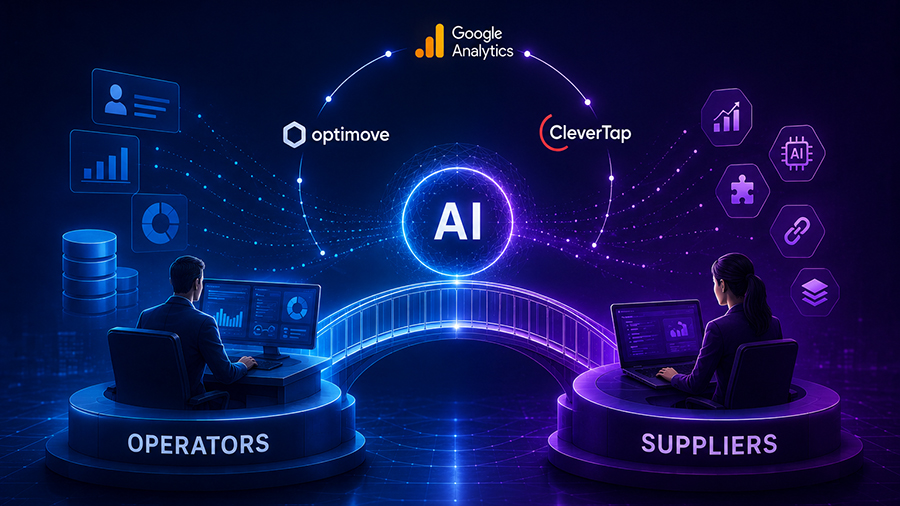
As AI begins to show tangible value in specific areas, it also becomes clear that adoption is not a single-track process. It is shaped by two distinct perspectives within the same ecosystem: those of the operators and those of the suppliers supporting them. While both are working towards a common goal, they are navigating very different realities.
For operators, the challenge is rarely about access to the data but about acting on it. Lottery systems generate large amounts of information across transactions, player behavior, and operational processes. The difficulty is to make this data more usable. In many cases, the data already exists, but it remains underutilized.
This is where AI has the potential to act as a bridge. By identifying patterns, predicting behavior, and enabling automated decision-making, it allows operators to move from hindsight to foresight. However, for this to work, outputs must be both intuitive and actionable, something that can be embedded into everyday workflows rather than sitting in isolation.
From solution providers’ point of view, the challenge isn’t about enabling AI, but about keeping pace with technological change outside of the lottery ecosystem.
Across martech and analytics, platforms such as Google Analytics, Optimove, and CleverTap are advancing rapidly, with AI embedded into their core capabilities, continuously refining segmentation, prediction, and engagement models at a scale that is difficult for any one vendor to replicate.
This points to a fundamental realization: there is no need to reinvent the wheel. The more effective approach, therefore, is to integrate with existing best-in-class platforms to enable operators to access advanced AI capabilities without attempting to recreate from scratch. This perspective also brings technology architecture into focus. Open, microservices-based platforms are far better positioned to support this model, allowing seamless integration with external tools. In contrast, closed systems face increasing limitations as the ecosystem continues to evolve.
Role of Architecture in AI Adoption
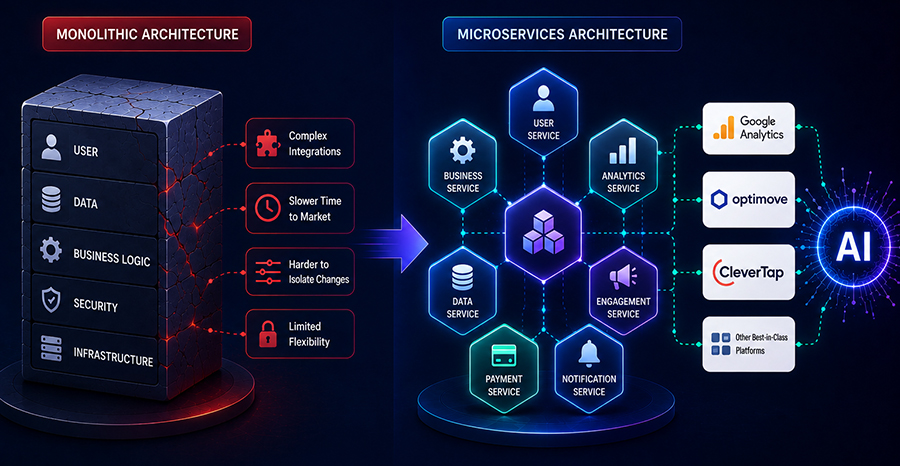
Across the lottery industry, many platforms have been built with a strong emphasis on stability, control, and long-term reliability. These priorities remain essential; however, platforms have not always been designed with interoperability and extensibility as primary considerations.
If integration is to play a meaningful role in enabling AI, platform architecture becomes a critical factor. Architectures that are built as tightly coupled, monolithic systems can make this process more challenging. Each integration may require significant effort, changes are harder to isolate, and introducing new capabilities can impact existing workflows. While this does not prevent integration, it can slow it down and limit flexibility over time.
In contrast, microservice-based architectures are better suited to support this approach. By breaking the platform into smaller, independent services, microservices allow different components to operate, scale, and evolve separately. This makes it easier to integrate with external systems, whether for analytics, player engagement, or AI-driven capabilities. New tools can be connected without requiring extensive changes across the entire platform.
This becomes particularly relevant when working with tools where AI capabilities are continuously advancing. The ability to integrate with such ecosystems depends not just on intent, but on whether the underlying platform is designed to support it.
Conclusion: From Possibility to Adoption
The conversation around AI in the lottery industry has clearly evolved. What bega n as a wave of excitement has moved towards a more grounded focus on how those capabilities can be applied in real environments.
Operators are no longer looking for broad capabilities. They are looking for solutions that fit, deliver measurable outcomes, and integrate with what already exists. At the same time, solution providers are recognizing that progress lies not in building everything, but in enabling access to a broader ecosystem.
This is what redefines AI adoption, not through large-scale transformation but through value addition by embedding into real workflows. In this context, the distinction between capability and applicability becomes critical. AI is no longer a differentiator but an expectation. What is needed, therefore, is disciplined evolution.
Learn more about Skilrock here: www.skilrock.com